|
|
|
|
|
|
|
GIDCO
140 Algonquin Parkway
Whippany, NJ 07981 USA
 973 884 2500 973 884 2500
 973 884 0392 973 884 0392
info@gidco.com

|
|
|

Jump To a Specific Topic:

+ Abrasives
When should I use an uncoated abrasive?
Uncoated abrasives are used for dry or wet grinding of cemented carbides and steel/carbide combinations.
Why coat a particle?
Copper coating (designated for dry grinding) improves crystal retention and promotes heat dissipation. Nickel coating (for wet grinding) also enhances crystal retention in the bond and reinforces the crystal to control fracturing.
What is CBN?
CBN was developed for the grinding and finishing of tool, die, and other hardened steels. It is not effective on tungsten carbide, non-ferrous metals and other non-metallic materials.
How do I create a microfinish?
To obtain fine microfinishes a lapping operation may be required. Our diamond compounds and specially processed micron size diamond powders are ideal for these operations. Compound is usually applied by hand, leather, felt polishing wheels, or machines specially designed for lapping.

+ Bonds
When should I use metal, resin, or vitrified bonds?
Metal - glass, ceramics, very high form retention
Vitrified - carbides, pcd, ceramics, hardened steel
Resin - carbides, ceramics, hardened steel
+ Concentrations
Why should I use a higher concentration?
Higher concentrations, 100 or 125, work well for corner and form retention. Higher concentrations usually are the most cost effective overall, except for CBN.
When can I use a low concentration?
Lower concentrations (75 or less) are used in larger wheels with large contact area, finer grit wheels, metal bonds for non-metallics and face wheels in many cases.
+ Grit/Mesh Sizes
What grit size should I use?
80, 100, 120 - Roughing and rapid stock removal
140, 150, 180 - Medium finishes, standard carbide tools and milling cutters
220, 240, 320 - Finer finishes, keener cutting edges
400 & Finer - Microfinishes, little stock removal
Note: To obtain fine microfinishes a lapping operation may be required. Our diamond compounds and specially processed micron size diamond powders are ideal for these operations. See the Abrasives section for more details.
How do grit sizes correlate with finishes?
This chart shows the finish which can be expected from various grit sizes.
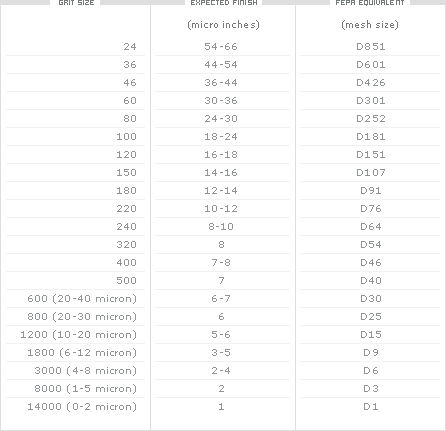
Note: Use this chart as a guide only. Machine type and condition, and type of material, can have an effect on the finish.
+ Machines/Coolants
Should I prep my machine for the use of a diamond wheel?
Yes. Flanges should be precision ground and balanced since they will actually become part of the wheel. Flanges, back plates, arbors and spindles should be absolutely clean, free of burrs and run true.
How do I mount the wheel?
Prep the machine like stated in previous question. Hand-tighten the wheel initially. By using an indicator and tapping lightly with a plastic hammer, indicate the wheel until it is at least .001" of true rotation. Tighten flanges securely and recheck with an indicator before using. The use of one permanent mounting for the life of the wheel should be practiced whenever possible.
What influence does coolant have on the operation?
Best results are obtained with an abundant flow of coolant, providing (a) cooling, (b) lubrication, (c) cleaning of the work-piece.
What is the best coolant when using CBN?
Oil coolant has proven to be most effective when grinding with CBN.
Is there any type of coolant I shouldn't use?
When using resinoid bonded diamond wheels avoid strong alkaline coolant solutions as they may react with and weaken the resin itself.
+ Shapes/Styles
What is the significance of a greater diamond or CBN depth?
The greater the diamond or CBN depth, the more cost effective the wheel. Each time depth is doubled, wheel life doubles at less than twice the individual cost of half-depth wheels.
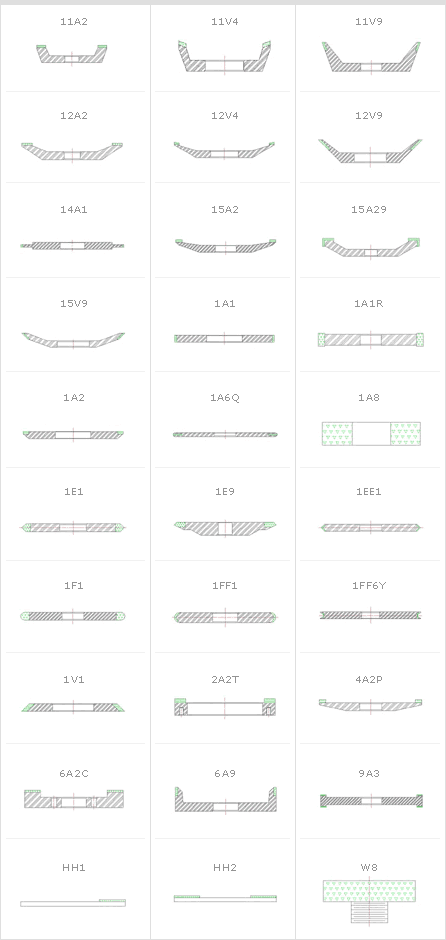
What do certain shapes look like?
Below is a table of popular shapes. Click on the image to enlarge.
+ Speeds/Feeds/Measures
What is the grinding, or "G" ratio?
A good measure of wheel life is the grinding ratio. This is calculated by dividing the cubic inches of material removed by the cubic inches of wear of the grinding wheel.
The "G" ratio decreases if the feed rate increases. The
"G" ratio increases as wheel size increases.
The total cost to grind is the wheel cost as measured by "G" ratio and the time cycles required. Wheel cost and grinding time cost must be optimized together for the lowest cost.
Is there a chart regarding wheel surface feet per minute, spindle rpm and wheel diameter?
Yes.
1. Select the grinding wheel SFPM you want.*
2. Read down to find the wheel diameter.
3. Match the two coordinates to find the equivalent spindle RPM.
+ Download
chart <pdf>
* If grinding CARBIDE DRY, the best wheel SFPM is between 2500 and 4500, 3500 being ideal.
* If grinding CARBIDE WET, the best wheel SFPM is between 5000 and 7000, 6000 being ideal.
* If grinding with CBN WET, the best wheel SFPM is between 7000 and 9000.
* If grinding with POROUS POLY BOND, the best wheel SFPM is between 3400 and 4200.
* If grinding with SC6/SC7 type bond, 2200 to 3000 SFM is suggested.
|
|
|
|
|
|